2026 Slide-Style Egg Rolling Box Reaches 70% Penetration: Food-Grade PP, Transparent Visibility, and Anti-Bump Protection for Modern Kitchens

In 2026, kitchen storage is no longer just about putting food somewhere in the refrigerator. Consumers now want storage products that save space, reduce mess, protect food, look clean, and make everyday routines easier. This is why the slide-style egg rolling box has become one of the most attractive products in the refrigerator organizer category. With a communicated market penetration signal of 70%, this product shows that many households, retailers, and kitchenware buyers are moving away from loose egg cartons and ordinary trays toward a more organized, visible, and protective egg storage solution.
The logic behind this trend is simple. Eggs are fragile, frequently used, and often stored in crowded refrigerator spaces. When they are placed loosely on shelves or kept in soft paper cartons, users may not clearly see how many eggs remain. They may accidentally bump one egg against another, place heavy items on top, or forget older eggs at the back of the refrigerator. A slide-style egg rolling box solves these daily problems with one compact structure: eggs roll forward automatically, the transparent body makes stock visible, the PP material supports food-contact use when manufactured to proper standards, and the anti-bump layout helps reduce shell collision during storage and access.
This product is not a decorative kitchen gadget. It is a practical refrigerator management tool. For families, it makes breakfast preparation faster. For elderly users, it reduces repeated searching and handling. For apartment owners, it saves space. For supermarkets and online sellers, it is easy to demonstrate. For brands and distributors, it is an ideal OEM and ODM product because it can be customized by capacity, color, logo, lid, slope angle, packaging, and retail positioning.
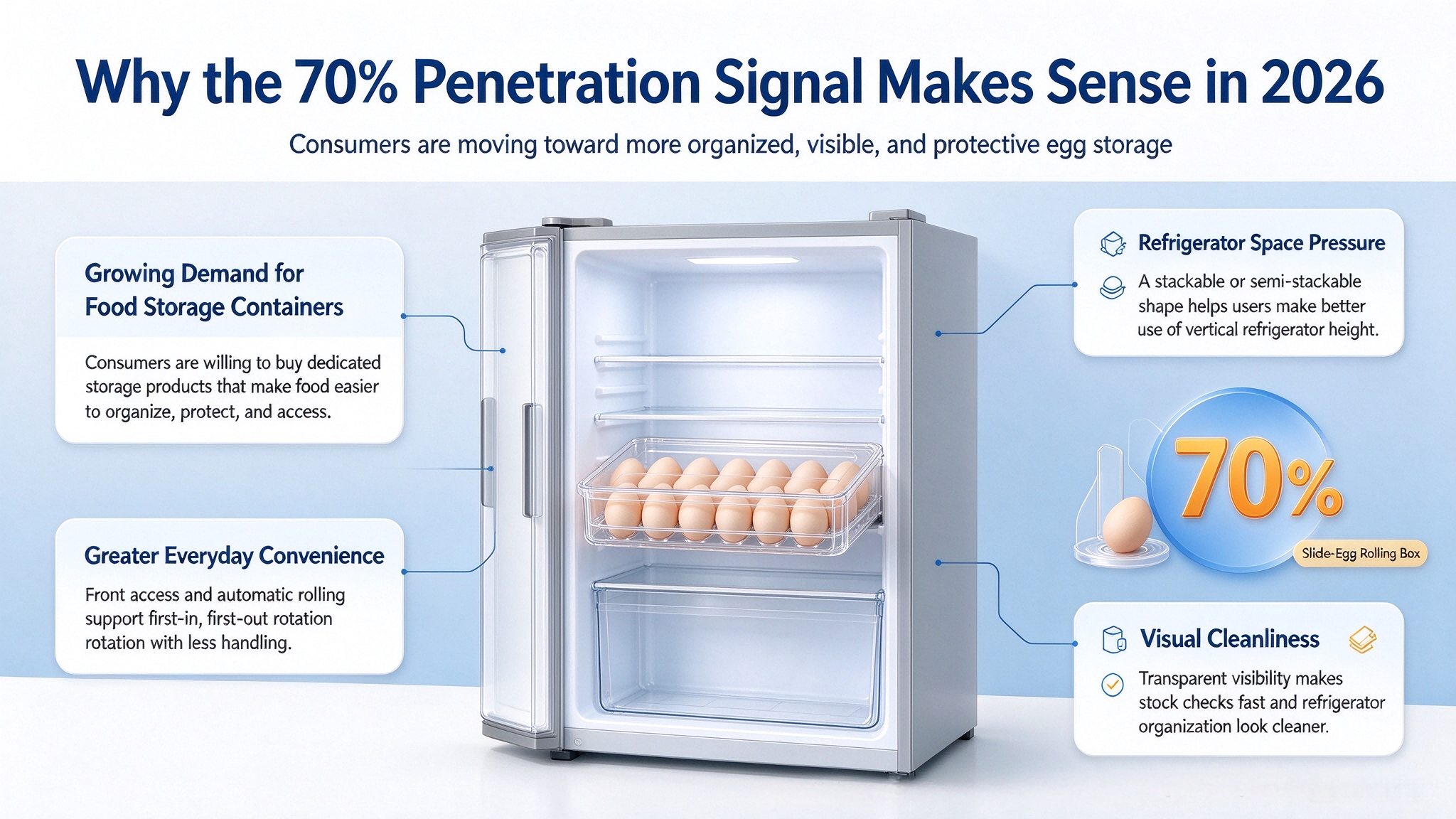
Why the 70% Penetration Signal Makes Sense in 2026
The first reason is the global demand for better food storage containers. Mordor Intelligence’s home food storage container market coverage shows that this category is analyzed by material, product type, application, and region, with plastic, glass, metal, bags, pouches, and containers all competing in the household storage space. This confirms a broader consumer shift: people are willing to buy dedicated storage products when those products make food easier to organize, protect, and access.
The second reason is refrigerator space pressure. Modern households often store milk, fruit, vegetables, leftovers, drinks, sauces, ready-to-eat food, frozen items, and meal-prep containers at the same time. Eggs are small, but their shape makes them difficult to stack safely. A flat egg tray uses shelf space but often leaves unused vertical space above it. A slide-style egg rolling box can be designed with a stackable or semi-stackable shape, allowing users to use refrigerator height more efficiently. This is especially valuable in apartments, dormitories, shared kitchens, rental homes, and compact urban refrigerators.
The third reason is convenience. Consumers do not want to lift multiple items just to find eggs. They want to open the refrigerator, see the remaining quantity immediately, and take one egg without disturbing the rest. The rolling design makes this possible. When the front egg is removed, the next egg moves forward naturally. This creates a “first-in, first-out” habit, helping users consume eggs in a more organized order instead of always taking the newest or easiest-to-reach eggs.
The fourth reason is visual cleanliness. Transparent organizers are popular because they make refrigerators look tidy. When eggs are hidden inside a paper carton, users must open the carton to check quantity and condition. When eggs are placed in a transparent rolling box, the remaining stock is visible at a glance. This matters in real life. A visible container reduces unnecessary opening, searching, touching, and rearranging. For e-commerce, the transparent design is also highly photogenic: product photos can clearly show eggs rolling, storage capacity, shelf placement, and clean refrigerator organization.
Food Safety Context: Why Egg Storage Needs More Attention
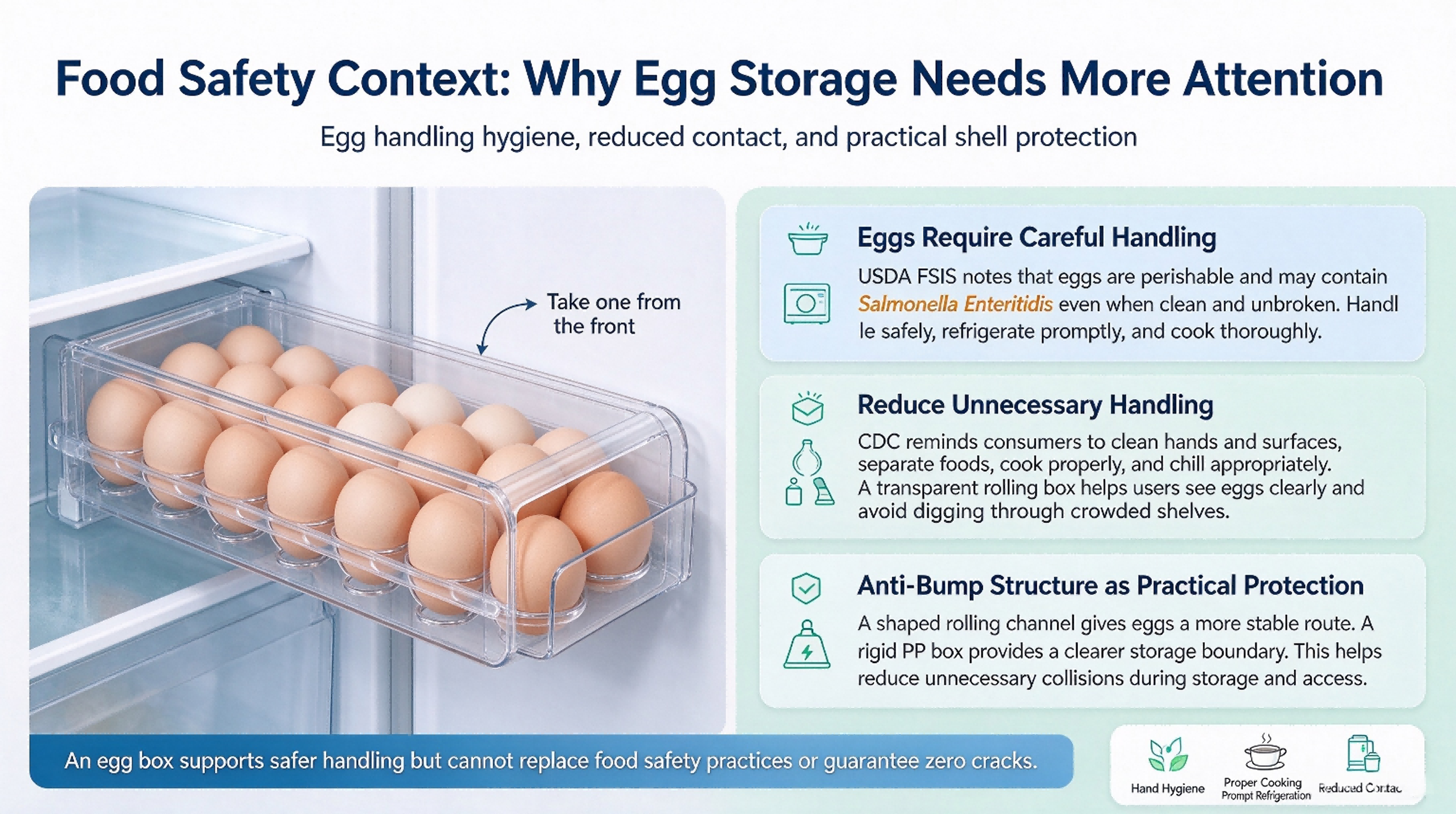
Eggs look simple, but they require careful handling. The USDA Food Safety and Inspection Service explains that eggs are perishable and that even clean, unbroken shell eggs may contain Salmonella Enteritidis; therefore, eggs should be handled safely, refrigerated promptly, and cooked thoroughly. This point does not mean that an egg box can replace food safety practices. It means that egg storage products should help users handle eggs more carefully and keep them organized in the refrigerator.
The CDC has also investigated Salmonella outbreaks linked to eggs and repeatedly reminds consumers to follow key food safety steps such as cleaning hands and surfaces, separating foods, cooking properly, and chilling foods appropriately. A slide-style egg rolling box supports this everyday hygiene mindset by reducing unnecessary egg handling. When users can see the eggs, take one from the front, and avoid digging through a crowded shelf, they reduce the number of touches and movements around fragile eggs.
Shell protection is another important point. A cracked egg is not just visually unattractive; it can increase safety concerns because the shell is the egg’s natural barrier. The product cannot guarantee that eggs will never crack, but an anti-bump structure can reduce unnecessary collisions during storage and access. Compared with loose placement on a shelf, a shaped rolling channel gives each egg a more stable route. Compared with a soft or damaged carton, a rigid PP box provides a clearer storage boundary. This is why the “anti-bump” feature should be explained as practical protection, not exaggerated as absolute safety.
Why Food-Grade PP Is a Strong Material Choice
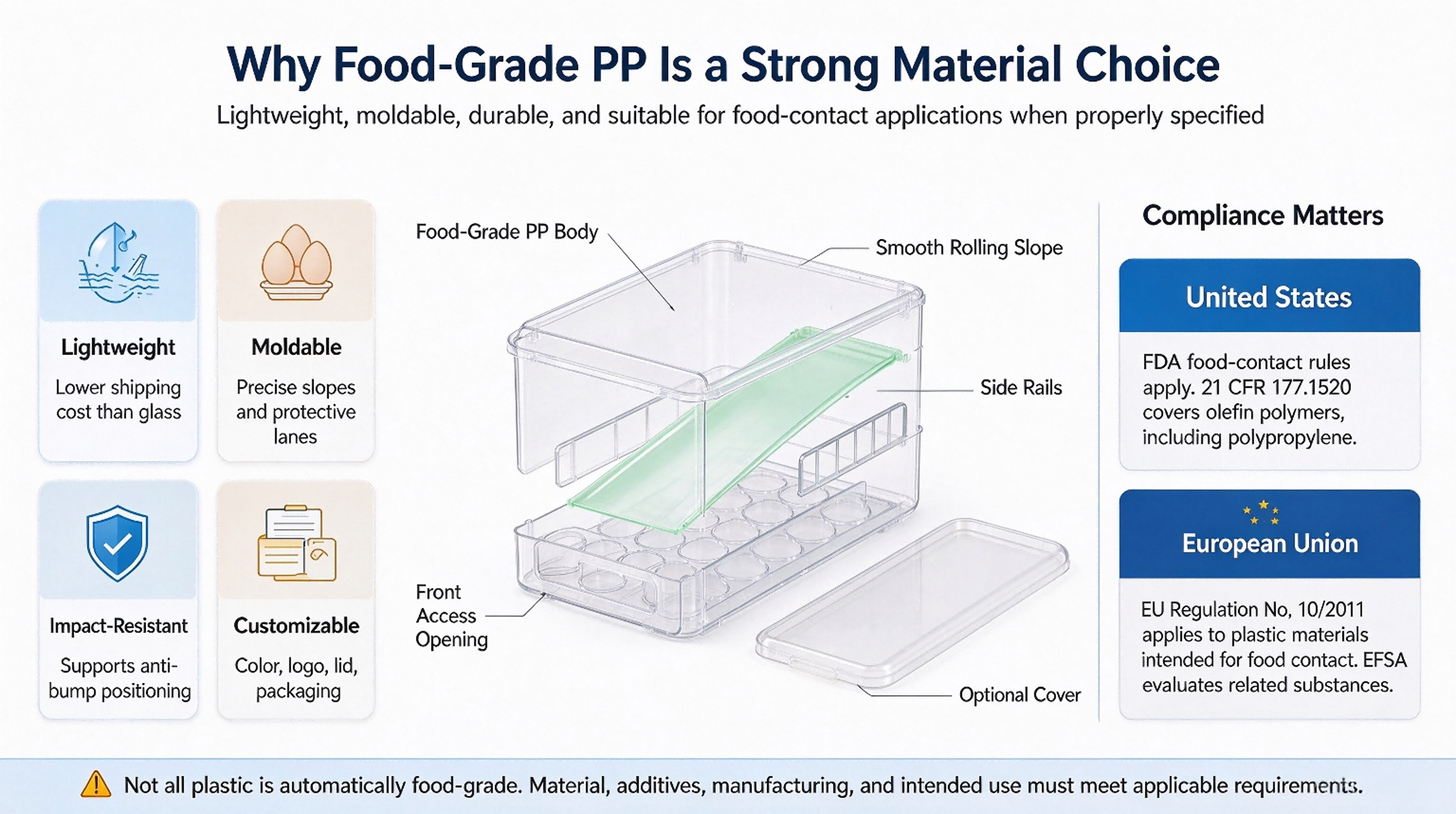
Food-grade PP, or polypropylene, is widely used in food packaging and household containers because it can be lightweight, moldable, durable, and cost-effective. However, responsible product communication should be precise: not every plastic item is automatically food-grade. The material, additives, manufacturing process, and intended use must meet applicable food-contact requirements in the target market.
In the United States, FDA food-contact rules include regulations for substances and materials that may come into contact with food. The FDA’s food-contact substance resources explain the regulatory framework for packaging and food-contact substances. More specifically, 21 CFR 177.1520 covers olefin polymers, including polypropylene, and states that listed olefin polymers may be safely used as food-contact articles or components when they meet the conditions of that section.
In the European Union, Commission Regulation (EU) No. 10/2011 sets specific rules for plastic materials and articles intended to come into contact with food. This is important for importers, supermarket buyers, and private-label brands selling into European markets because food-contact compliance is not just a marketing phrase; it is a regulatory expectation. EFSA’s Food Contact Materials panel also evaluates the safety of substances used in packaging and materials intended to contact food, including plastics and recycled plastic processes.
For our slide-style egg rolling box, food-grade PP gives several commercial advantages. It can be molded into a smooth rolling slope, a stable shell, side rails, front access opening, and optional cover. It is lighter than glass, which helps reduce shipping cost. It is more impact-resistant than many brittle materials, which supports anti-bump positioning. It can be produced in transparent or semi-transparent versions depending on the PP grade and design requirements. It also supports color customization, logo printing, private-label packaging, and mass production for retail and e-commerce.
Transparent Visibility: Why “See-Through” Design Sells
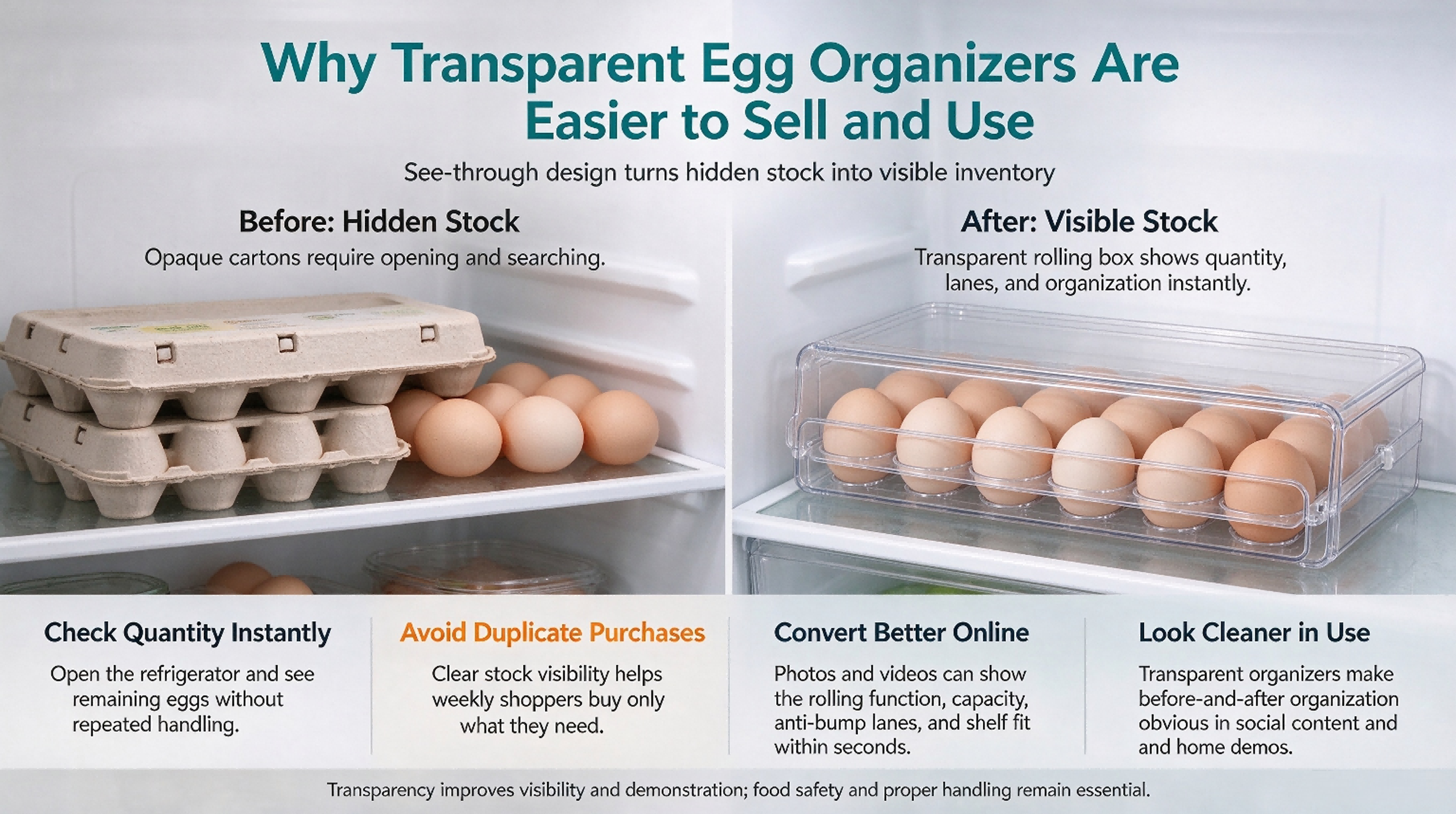
The transparent body is not only about appearance. It solves a real kitchen problem: users often do not know how many eggs remain. When eggs are hidden in an opaque box or original carton, the user must pull out the container and open it. This may sound minor, but repeated every day, it becomes inconvenient. A transparent rolling egg box allows users to check quantity instantly.
This visibility also helps reduce duplicate purchases. Many families buy eggs during weekly shopping. If the refrigerator looks messy, they may buy another carton even when eggs are still available. A transparent organizer makes stock obvious. For consumers who plan meals, bake frequently, or prepare breakfast daily, this is a practical benefit.
For sellers, transparent design improves conversion. Online shoppers cannot touch the product, so they rely on photos and videos. A transparent egg box can show the rolling mechanism, the number of eggs stored, the thickness of the shell, the anti-bump lanes, and the way it fits inside a refrigerator. It is much easier to sell a product when the customer can visually understand it within three seconds.
Transparency also creates a cleaner refrigerator aesthetic. A visible container gives a sense of order and freshness. In social media content, kitchen organization videos, refrigerator restock videos, and home storage demonstrations, transparent organizers are especially effective because they make the before-and-after difference obvious. A messy egg carton becomes a neat rolling box; scattered eggs become a controlled line; hidden stock becomes visible inventory.
Slide-Style Rolling Access: The Function Customers Understand Immediately
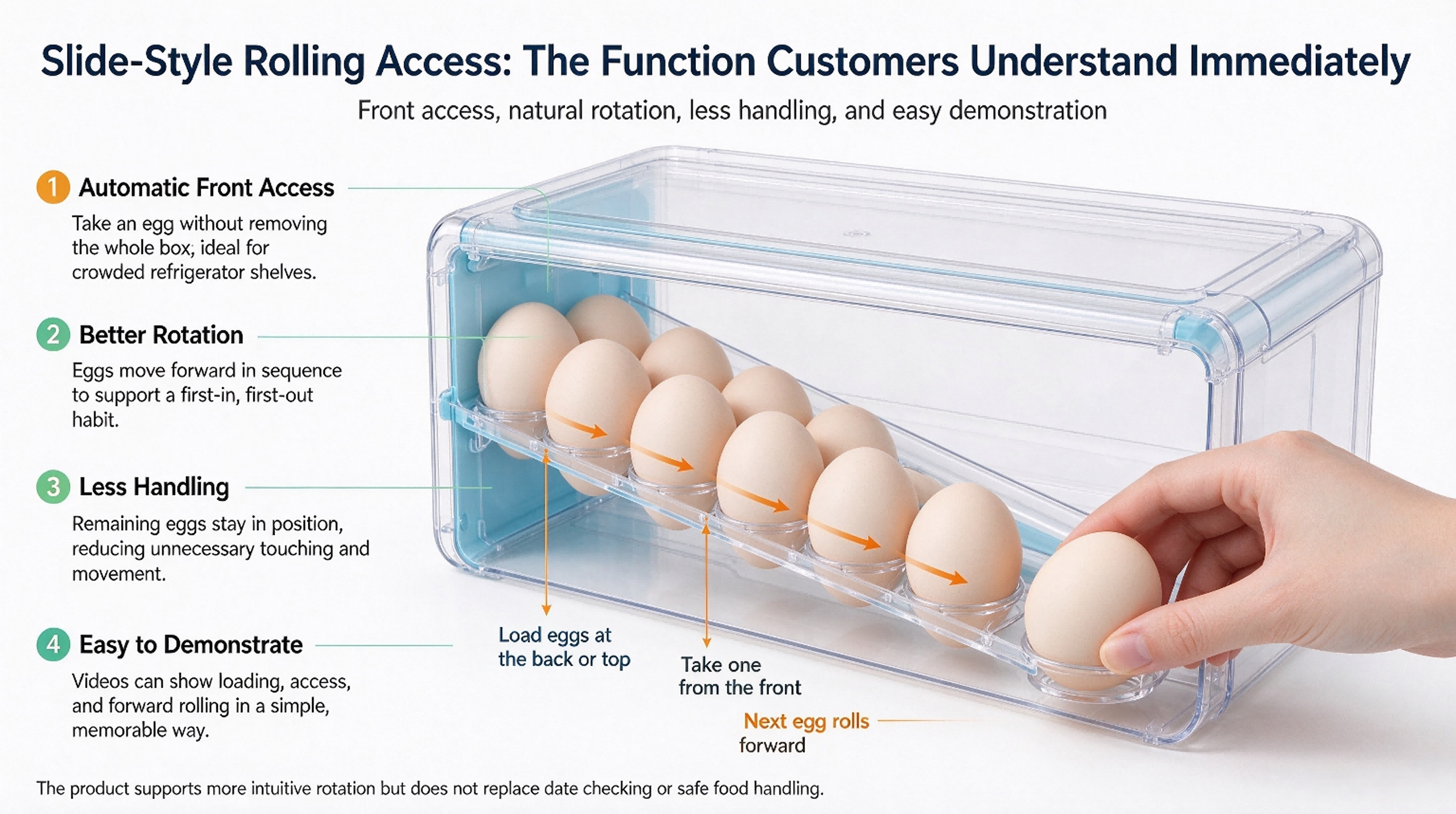
The slide-style rolling structure is the core feature of the product. It is easy to explain: eggs are placed at the back or top lane, and each egg moves forward naturally when the front egg is taken. This makes daily use smoother and more organized.
The first benefit is automatic front access. Users do not need to remove the entire box to take an egg. They simply take one from the front. This is especially useful when the refrigerator shelf is crowded. A traditional egg carton often requires pulling out the whole carton, opening the lid, selecting an egg, closing the carton, and pushing it back. The rolling box reduces steps.
The second benefit is better rotation. In food storage, first-in, first-out is a practical habit. It helps users consume older items before newer ones. The rolling design naturally supports this pattern by moving eggs forward in sequence. The product does not replace date checking, but it makes rotation more intuitive.
The third benefit is less handling. Every time eggs are touched, moved, or rearranged, the risk of dropping or bumping increases. A rolling channel reduces unnecessary movement. The user takes from the front, and the remaining eggs stay in position. This is a strong selling point for families with children, elderly users, and busy kitchens.
The fourth benefit is demonstration power. In videos, rolling access is satisfying and easy to show. A product that moves is more engaging than a static storage box. For e-commerce sellers, this creates strong content potential: “load the eggs, pull one out, watch the next egg roll forward.” This kind of demonstration is simple, memorable, and persuasive.
Anti-Bump Protection: Why Egg Shells Need Structural Care
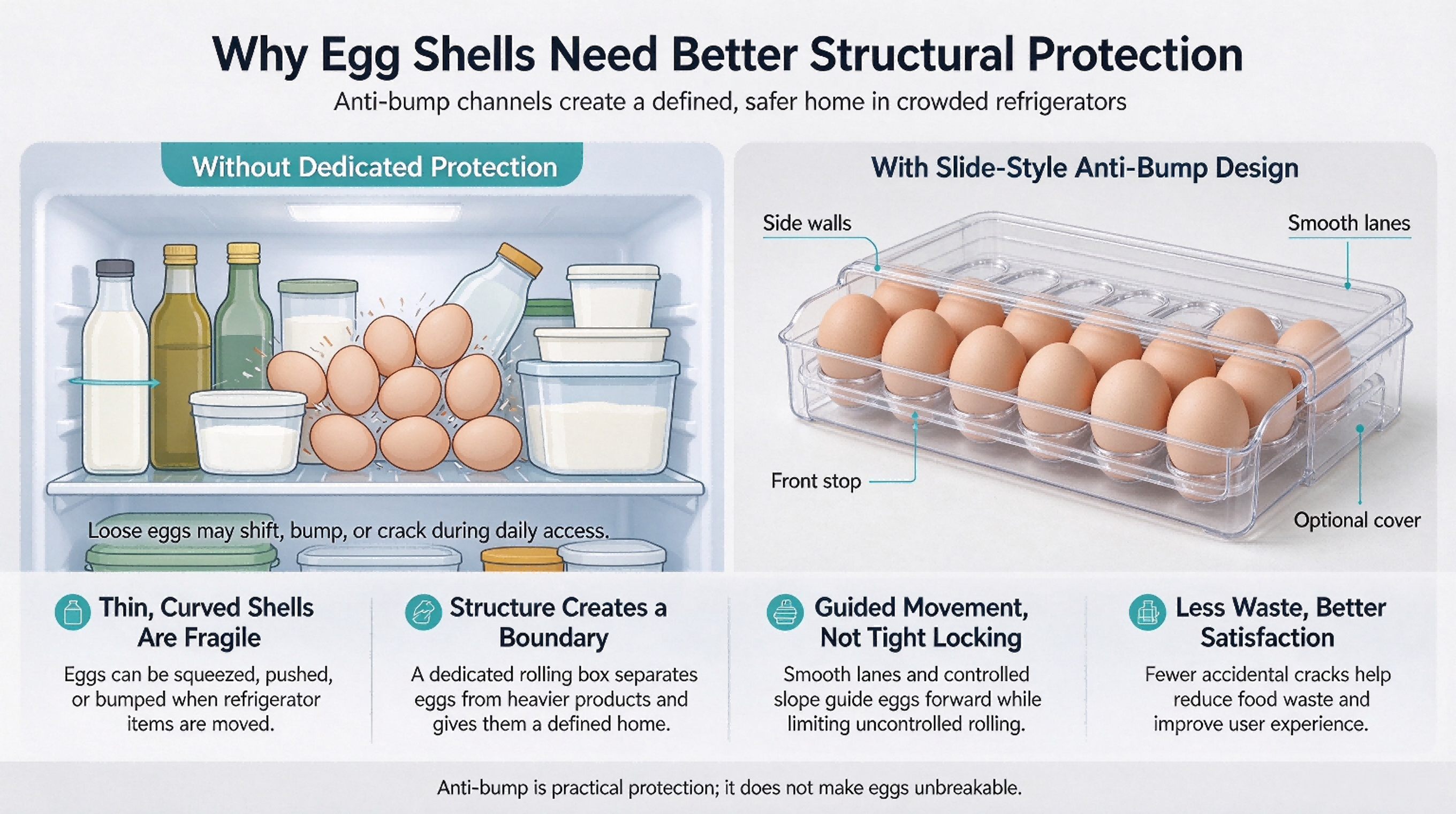
Eggs are fragile because their shells are thin and curved. In crowded refrigerators, they may be squeezed by bottles, pushed by containers, or bumped when users move items. A slide-style egg rolling box provides a dedicated space that separates eggs from heavier products.
The anti-bump value comes from structure. A good design should include side walls, smooth rolling lanes, controlled slope, stable front stop, and a lid or cover option depending on the model. The goal is not to lock the egg too tightly. The goal is to guide movement while preventing uncontrolled rolling, side impact, and random collision.
This matters because cracked eggs can create waste. Even when a cracked egg is not visibly leaking, many consumers will discard it out of caution. If the product helps reduce cracks caused by storage accidents, it saves money and improves user satisfaction. For retailers, this is an easy value message: “Protect every egg, reduce waste, organize your refrigerator.”
Anti-bump design is also important during user interaction. When someone quickly opens the refrigerator, pulls out milk, or moves a container, loose eggs can shift. A dedicated rolling box gives eggs a defined home. This reduces the chance that eggs are accidentally touched by other items. In a family refrigerator, where several people may open the door many times per day, this protection becomes even more valuable.
Space-Saving Refrigerator Organization
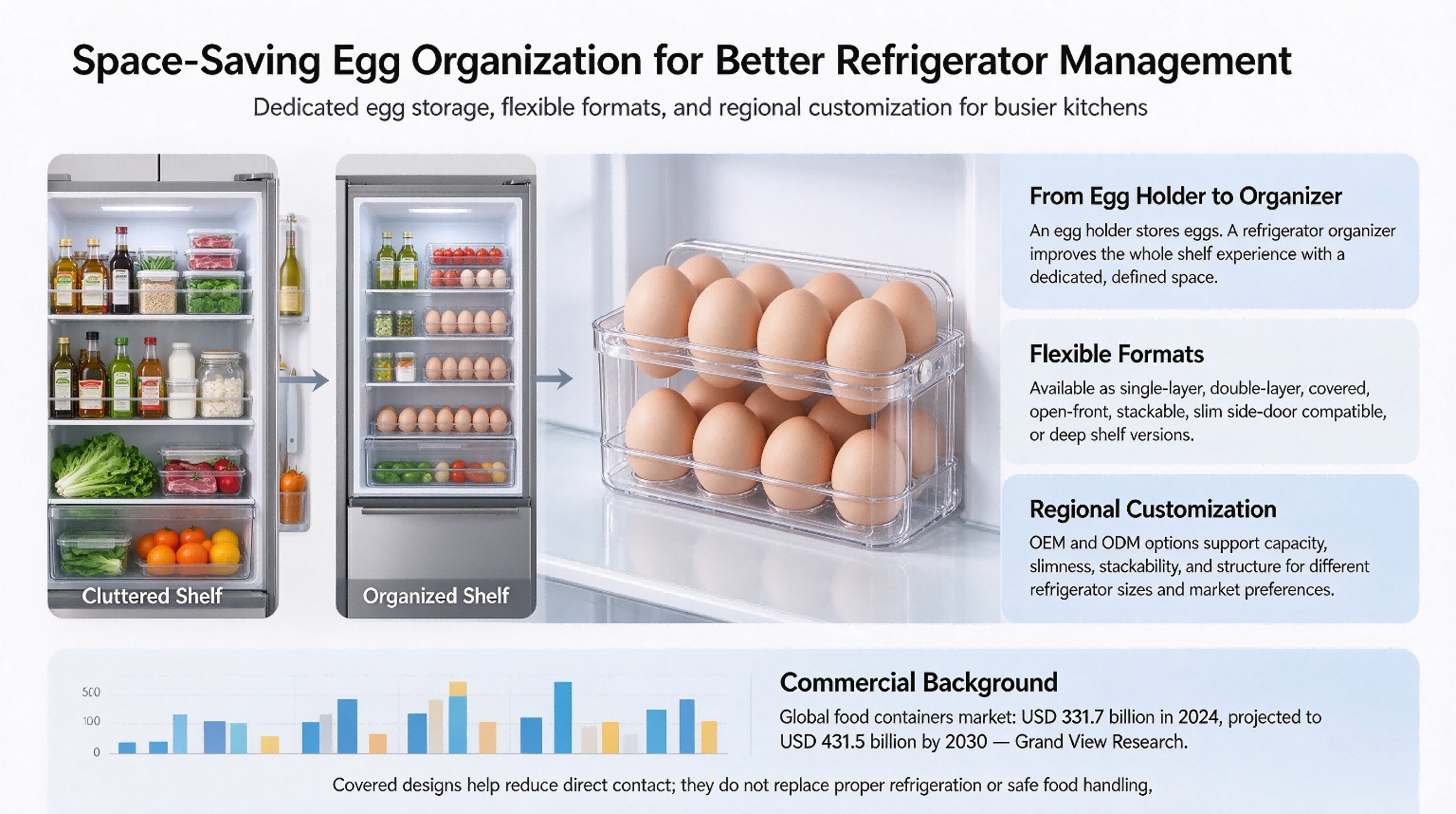
The egg rolling box should be promoted as a refrigerator organization solution, not only as an egg holder. The difference is important. An egg holder stores eggs. A refrigerator organizer improves the whole shelf experience.
The product can be designed in several formats: single-layer rolling box, double-layer rolling box, covered box, open-front dispenser, stackable organizer, slim side-door compatible version, or deep shelf version. Different markets have different refrigerator sizes, so OEM and ODM customization is highly valuable. North American customers may prefer larger capacity, while apartment-focused markets may prefer slim and compact models. European and Asian kitchens may value stackability and small-space efficiency.
The box also helps keep eggs separated from odors and moisture when a lid is included. While it does not replace proper refrigeration or food safety habits, a covered organizer can reduce direct contact with other refrigerator items and help maintain a cleaner storage zone. The user experience is simple: eggs have one place, the refrigerator looks tidier, and breakfast preparation becomes faster.
Grand View Research reports that the global food containers market was valued at USD 331.7 billion in 2024 and is projected to reach USD 431.5 billion by 2030, with growth from 2025 to 2030. This supports the broader commercial background: food storage is a large, active category, and consumers continue to invest in containers that improve convenience, freshness, and organization.
Conclusion
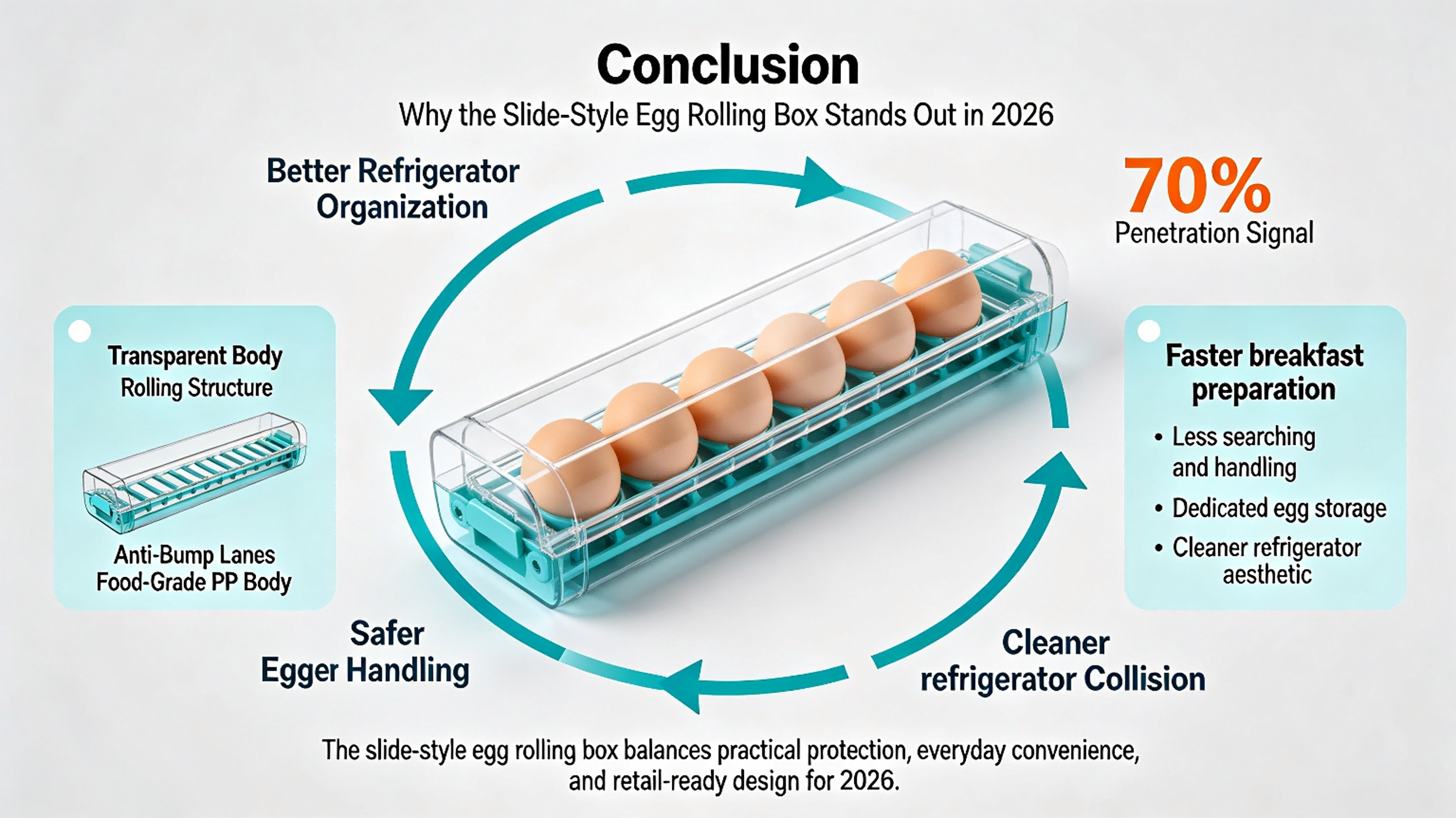
The slide-style egg rolling box is one of the most promising kitchen storage products for 2026. Its communicated 70% penetration signal reflects real consumer needs: better refrigerator organization, safer egg handling, clearer visibility, reduced shell collision, and faster access. Made with properly specified food-grade PP, the product offers a strong balance of light weight, durability, moldability, and retail-friendly cost. The transparent body helps users see remaining eggs at a glance. The rolling structure supports easy front access and better rotation. The anti-bump design helps protect fragile shells from unnecessary impact.
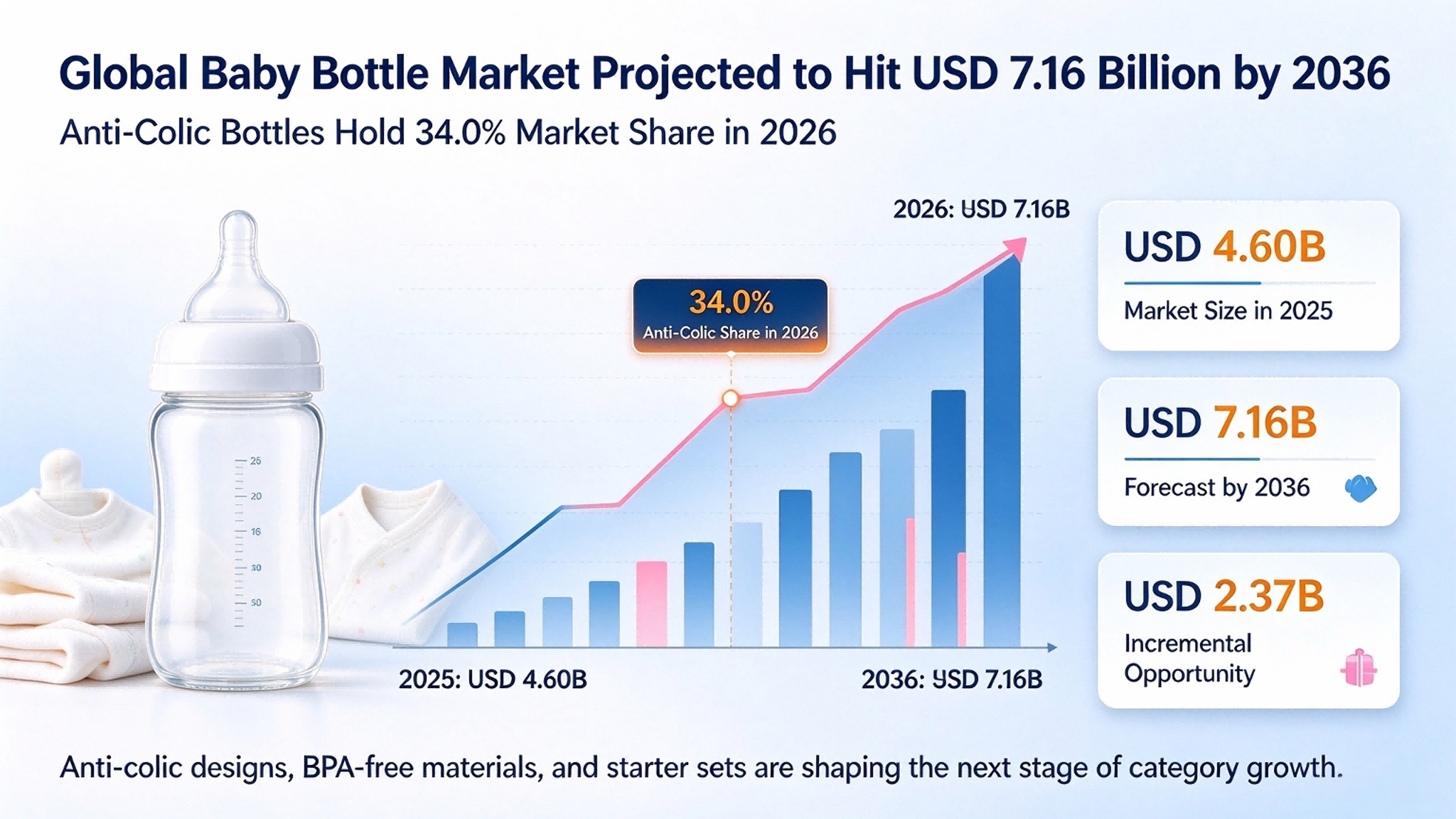
Global Baby Bottle Market Projected to Hit USD 7.16 Billion by 2036; Anti-Colic Bottles Hold 34.0% Market Share in 2026
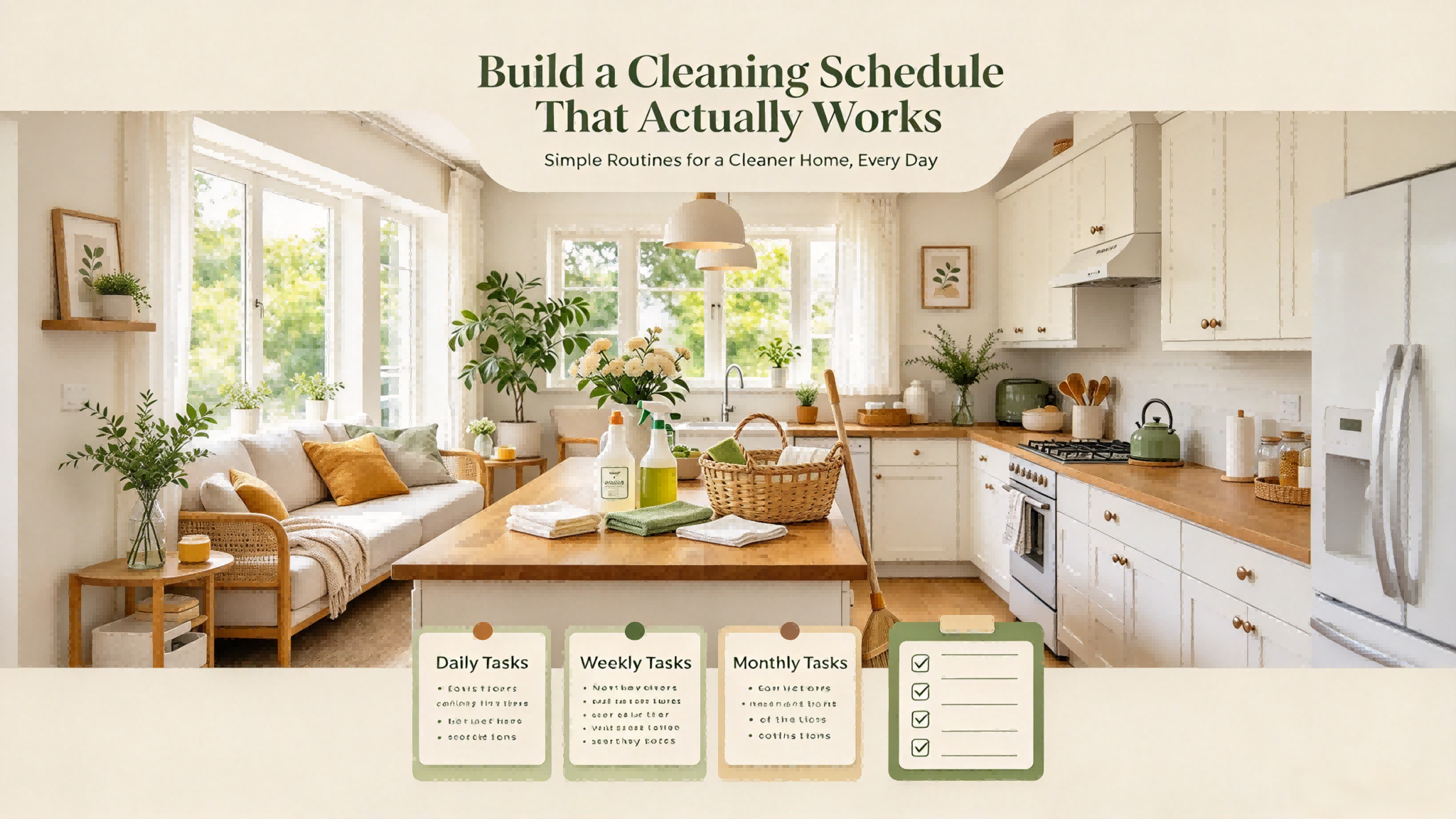
The complete guide to building a cleaning schedule that works
Related Article